
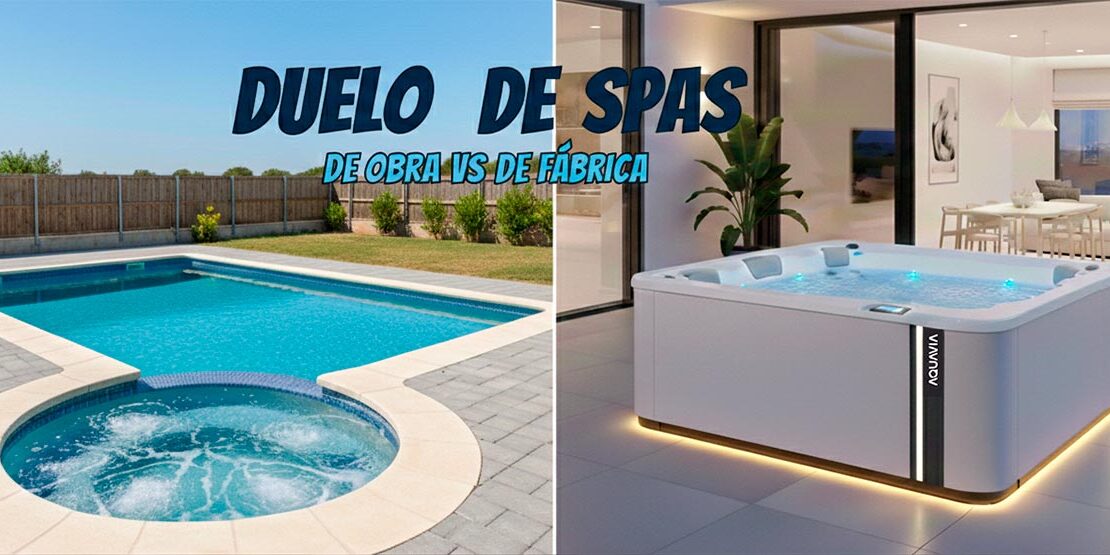
Choosing between a built-in hot tub (in-ground, custom-designed, usually attached to a swimming pool) and a prefabricated outdoor hot tub (self-standing or portable hot tub) is not a matter of “luxury” versus “practicality”. Above all, it is a decision of home engineering: structure, insulation, plumbing, electricity, maintenance accessibility, and total purchase cost.
To avoid vague comparisons, here are the points that actually change: consumption (water and energy), year-round use, maintenance, safety, durability, repairability, and flexibility to enjoy the benefits of a hot tub with full guarantees.
Navegación rápida
Before comparing: what are we talking about?
- Prefabricated outdoor hot tub: shell and base integrated, with equipment (pumps, heater, filtration and electronics) designed as a single system. Installation usually requires a stable base, an electrical connection and filling. In 4-seater models, volumes are typically around ~800–1,000 L, depending on the model.
- Built-in hot tub: shell built on-site (concrete/gunite, blockwork, etc.) and equipment selected and assembled by the installer. Capacity and performance depend more on the project (insulation, access panels, technical room ventilation) than on the “material” itself.
In both cases, consumption and user experience are shaped by insulation, the thermal cover, the target temperature, and the climate.
Comparison table: built-in hot tub vs prefabricated outdoor hot tub
Note: numerical values depend on size, insulation quality and usage patterns. In electricity, what matters most is usually keeping the water hot (more than “running the jets for 20 minutes”).
For this comparison, we will assume both examples have the same size.
| Factor | Built-in hot tub (in-ground) | Prefabricated outdoor hot tub |
|---|---|---|
| Water consumption (fill) | Variable: depends on the design. If oversized, volume and heating cost increase, but we will use a typical 4-seater hot tub which usually sits around ~800–1,000 L. | More predictable: 4-seater models typically range around ~800–1,000 L depending on the model. |
| Electric consumption (use/temperature) | Highly sensitive to construction losses and thermal bridges: it can be excellent or inefficient if poorly executed. | Integrated and optimized system; performance is more consistent across equivalent installations. |
| Versatility | High: custom shape, size and placement; allows hybrid solutions (hot tub + water sheet), although it cannot be relocated. | High, but limited to catalog options and available geometries/models. On the other hand, it can be moved to a different location or home. |
| Year-round use | Possible if designed for it (insulation + cover + technical setup). Otherwise, winter increases costs. | Heated and designed for year-round use with cover and insulation built into the model. |
| Maintenance | Depends on accessibility. Without easy access panels, maintenance becomes more expensive and complicated. | Standard access through panels; consumables and spare parts are usually standard and easier to source. |
| Purchase cost (equipment) | “Piece-by-piece” equipment; it may seem cheap until the full system is added up. | Fixed price for the complete unit; easier comparison between models. |
| Installation cost | High: building permits + civil works, waterproofing, plumbing, electricity, finishing. | Medium: base, leveling, electrical connection and commissioning. No building permits. |
| Time until use | Weeks: construction, curing, leak tests and finishing work. | Usually 1 day if the electrical pre-installation and base are ready. |
| Safety | Fully dependent on the design and execution: protections, grounding, conduit routing, etc. | The unit is designed as an integrated system; still requires competent electrical installation. |
| Thermal insulation | Can be outstanding if designed properly; if you rely on “mass”, it usually loses more heat and increases electricity use. | Typically includes shell insulation and a cover sized for the model. |
| Repairability | If you have to break/remove parts to access equipment, repairs become expensive and uncertain. | Access via panels; replacing pumps, heaters or electronics is more routine. |
| Structural durability | Very high if structure and waterproofing are properly solved. | Very high if built with the right materials. |
| Aesthetics and integration | Maximum architectural integration: it can look “native” in a garden or terrace. | Good integration with decking/partial recessing, but it remains a standalone object. |
| Noise and vibration | Can be controlled if designed properly (bases, anti-vibration mounts, technical room). If not, it may be amplified. | Generally low; depends on the model and the quality of the base/support. |
| Mobility | None: it stays where it is. | High: it can be relocated (with logistics and cost). |
| Impact on property value | May add value if well executed and documented; if it causes problems, it can reduce value. | Lower “real estate” impact; if not wanted, it can be removed. |
The cost category almost nobody calculates
In every project there are hidden costs that are not reflected in the initial purchase price; these could be some of them.
Insulation matters more than “built vs factory-made”
A hot tub loses energy through exposed surface area, thermal bridges and evaporation (if there is no cover). That’s why a built-in hot tub is not automatically more efficient: without continuous insulation and a good cover, it can consume more than a well-designed prefabricated unit.
Real electricity consumption is better explained by habits
The user experience is usually impacted more by maintaining the temperature (filtration, heat loss, climate and frequency of use) than by the occasional use of jets or bubbles.
Maintenance: accessibility > shell material
A flawless built-in hot tub with hard-to-access equipment can become a source of cost and downtime. A prefabricated unit, on the other hand, tends to simplify diagnostics and component replacement.
Practical checklist: when each one makes sense
A built-in hot tub usually makes sense if…
- You need a non-standard shape or size.
- There is room for a serious technical project (insulation, access panels, drainage, ventilation, electricity).
- You accept the higher real cost including construction + equipment + commissioning + maintainability.
A prefabricated outdoor hot tub is usually better if…
- You want predictability (price, timelines and typically more consistent performance).
- You value easy maintenance and commonly available spare parts.
- You want flexibility (relocation, resale, moving house).
- You want to minimize construction work and reduce execution risk.
Safety: the non-negotiable point
Outdoor use means water, barefoot people and electricity. Make sure the installation is done properly: appropriate RCD protection, grounding, correct cable sizing and weather-rated materials. Electrical safety is not an “extra”: it is the minimum requirement.
Why Aquagrup does not sell built-in hot tubs
A factory-made hot tub reduces uncertainty: a closed product, no building permits, no impact on the property tax (IBI), installation in 1 day and more straightforward maintenance.
A built-in hot tub can be superior in integration and customization, but only if you treat it as a technical project in itself (design, building permits, insulation, cover and accessibility). The result is usually expensive and, if the above conditions are not met, unsatisfactory, no matter how attractive the final look may be.