
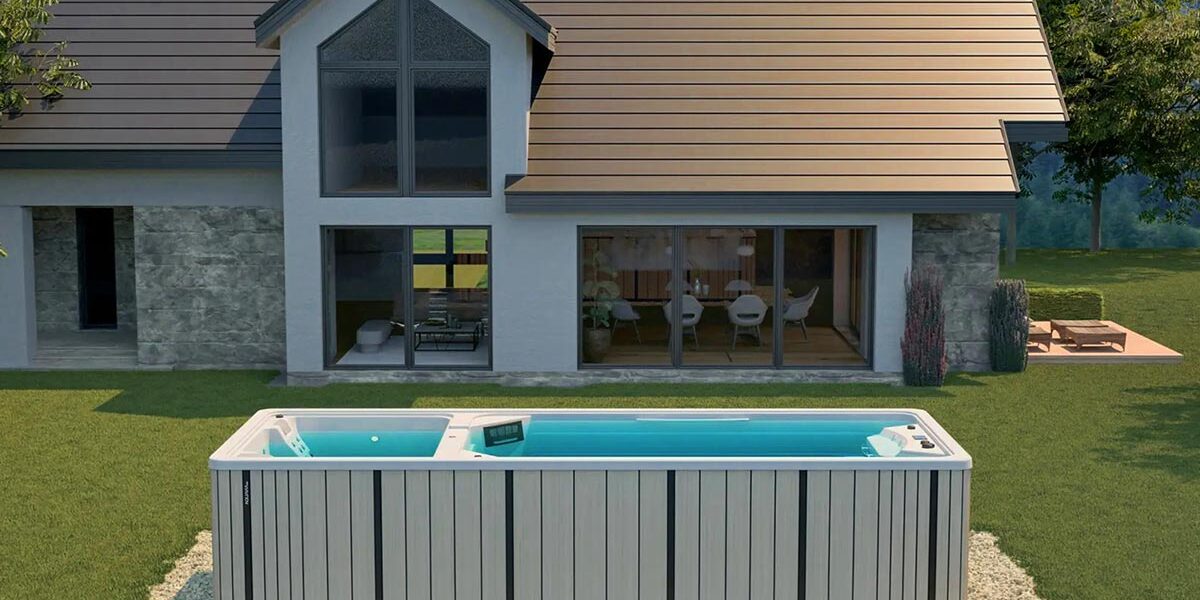
In the collective imagination of domestic luxury, the traditional swimming pool has for decades been a kind of totem: a symbol of space, leisure, and summer. However, contemporary life (more intense, more irregular, less seasonal) has been shifting desire away from the “large body of water” toward something more usable, more consistent, and, in a sense, more intelligent. This is where the swim spa fits in: a hybrid solution that brings together swimming, aquatic exercise, and hydrotherapy in a compact, climate-controlled format that can be reasonably integrated into high-end private homes.
It is worth clearing up a common misunderstanding: a swim spa is neither “a small pool” nor “a long jacuzzi.” It is an aquatic system with its own logic. Its defining feature is counter-current swimming: instead of requiring linear distance, the unit generates an adjustable current against which you swim without moving forward. If you add a massage seating area, hydrotherapy jets, and thermal control, the result is a multifunctional space that can be used daily (not just on August weekends) and which, when properly chosen and installed, offers a distinctive balance between health, sport, and relaxation.
Navegación rápida
- 1 What exactly is a swim spa
- 2 How counter-current swimming works (and why it is not a minor detail)
- 3 What it is used for in a private home
- 4 Swim spa vs traditional pool: the comparison
- 5 Swim spa vs jacuzzi: real similarities and decisive differences
- 6 Advantages of a swim spa at home
- 7 Limitations and drawbacks: what to know before falling for a swim spa
- 8 Technical requirements to install a swim spa in a high-end home
- 9 Maintenance in practice
- 10 What to look for when choosing a swim spa
- 11 What is your decision?
What exactly is a swim spa
A swim spa is a prefabricated unit (usually with a composite shell and a self-supporting structure) that integrates:
- Swimming area with current generated by jets or turbines.
- Aquatic exercise area (walking against the current, mobility work, strength training with accessories, etc.).
- Spa area with seating, massage jets, and hydrotherapy.
- Filtration and water treatment systems typical of a domestic spa.
- Heating and thermal insulation for use across multiple seasons (and, in many cases, year-round).
The idea is not to replicate the social experience of a large pool, but to offer a functional one: swimming, training, recovery, and relaxation in a single system. In a private home, this often translates into a “private wellness” installation designed for everyday use: 30 minutes of exercise first thing in the morning, aquatic stretching in the evening, or a warm soak to end the day.
How counter-current swimming works (and why it is not a minor detail)
The core of a swim spa is the counter-current system. Broadly speaking, there are two families:
- High-pressure jets: they produce a powerful and adjustable flow. They are common and effective, although the “river-like” feel can vary depending on nozzle design and flow distribution.
- Propulsion-based counter-current flow: they tend to generate a wider and more uniform current. They are often preferred by swimmers seeking a more continuous, less “segmented” experience.
For the end user, the practical issue is this: it is not just about “how strong it pushes,” but how it pushes. A narrow current can feel uncomfortable or unstable; an overly turbulent one can cause fatigue due to technique rather than physical condition. That is why the sensible choice is not “more power,” but better hydrodynamics and control.
What it is used for in a private home
A well-designed swim spa usually covers three purposes that rarely coexist in a traditional pool:
Swimming and cardio without depending on length
The counter-current allows swimming in a compact space. This supports a consistent cardiovascular training routine, without the spatial cost (and often bureaucratic and landscaping cost) of a conventional pool. For homeowners, the value is not “having water,” but being able to use the water regularly.
Aquatic exercise and mobility work
The aquatic environment reduces joint impact and facilitates exercises that can be more aggressive on land: gentle training against the current, strength work with bands or aquatic dumbbells, mobility, balance, and stabilization. In private homes, this is particularly appealing for people who alternate between sport and periods of stress or sedentary lifestyle: the swim spa supports both training and physical “reset.”
Domestic spa and hydrotherapy
The spa area provides muscle relaxation and wellbeing: jets targeting the back, lower back, or legs, and temperatures that support recovery. It does not replace clinical treatment when needed, but it works as a domestic recovery tool, especially in demanding lifestyles.
Swim spa vs traditional pool: the comparison
The traditional pool offers something the swim spa does not aim to replicate: space, play, social interaction, and a visual relationship with the garden. The swim spa, on the other hand, usually excels in year-round use, thermal control, and functional training in more compact spaces.
| Criterion | Swim Spa | Traditional pool |
|---|---|---|
| Year-round use | High (heatable, coverable) | Variable (highly seasonal without heating) |
| Space required | Compact and predictable | Large (and with greater impact on the plot) |
| Swimming training | Counter-current in place | Linear swimming (depends on actual length) |
| Construction and installation | Faster, less invasive, no building permits required | More complex, longer timelines, building permits and multiple professionals required |
| Maintenance | Lower volume, more controlled | Higher volume, more outdoor exposure |
| Social and aesthetic experience | More intimate and functional | More landscape-oriented and recreational |
For the end user in a private home, the decision usually revolves around an honest question: do I want a summer architectural feature or a year-round wellness tool? If the answer is the latter, the swim spa begins to make compelling sense.
Swim spa vs jacuzzi: real similarities and decisive differences
Comparing a swim spa with a jacuzzi is useful because both share the same DNA: a heated vessel, continuous filtration, and hydrotherapy jets. The difference is that the swim spa adds an active component: the possibility to swim and train. In domestic use, this changes the role of the equipment: it goes from pure relaxation to habit.
| Criterion | Swim Spa | Jacuzzi / traditional spa |
|---|---|---|
| Main purpose | Exercise + relaxation + hydrotherapy | Relaxation + hydrotherapy |
| Swimming / counter-current | Yes | No |
| Versatility of use | Very high | High (therapy-focused) |
| Space required | Greater | Smaller |
| Consumption in “training” mode | Higher (pumps/counter-current) | Not applicable |
Advantages of a swim spa at home
In a private home, a swim spa is valued less for its list of features and more for what it enables in real life. These are common advantages, stated cautiously and without overpromising:
- Extended annual use: heating and optional covers allow for consistent use in colder or intermediate seasons.
- Training without commuting: reduces the logistical friction of going to a pool or gym, the main enemy of consistency.
- Low-impact exercise: water cushions and supports cardiovascular and mobility work with less joint stress.
- Compact footprint: viable where a conventional pool would be disproportionate or unfeasible (small plots, patios, large terraces).
- More predictable installation: as a prefabricated unit, many construction uncertainties are reduced (though not eliminated).
- Lower water volume: facilitates chemical control and generally simplifies management compared to large open pools.
- Hydrotherapy in the same system: massage and muscle recovery without installing a second unit.
- Privacy: for many high-end users, training at home has intangible value.
- Diverse family use: not everyone will use it for swimming; different profiles often coexist: sport, light play, relaxation, recovery.
- Integration with outdoor architecture: with proper surrounding design (decking, pergola, lighting, vegetation), it can become a contemporary landscaping feature.
- Temperature control: key to adapting use (cooler for training, warmer for relaxation).
- Lifestyle value: not so much abstract “property value,” but improved quality of living.
Limitations and drawbacks: what to know before falling for a swim spa
A swim spa also has limitations. Ignoring them often leads to frustration or suboptimal installation.
- It does not replace the experience of a large pool: if you are looking for space, group use, and resort-like aesthetics, this is not its natural domain.
- Current quality is critical: two units may both be “swim spas” yet offer very different swimming experiences.
- Variable energy consumption: maintaining temperature and generating flow in training mode has a cost. Efficiency depends on insulation, climate, habits, and cover usage.
- Requires maintenance discipline: less water does not mean “no maintenance”; it means more concentrated and controlled maintenance.
- Technically demanding installation: structural base, dedicated electricity, service access, and drainage are non-negotiable.
Technical requirements to install a swim spa in a high-end home
This is where a flawless domestic project is separated from an expensive whim with recurring issues. Key requirements usually include:
1) Structural base and loads
A filled swim spa can weigh several tons. It must be installed on a concrete slab or structural platform capable of supporting the full load with margin, while remaining flat and level. On terraces or upper floors, a structural analysis is advisable.
2) Dedicated electrical system and safety
A swim spa typically requires a dedicated electrical line, proper differential protection, and installation by a qualified professional. Available household power must also be assessed realistically.
3) Delivery and installation access
Often underestimated: the unit arrives as a large volume. Crane access or special maneuvers may be required. Entry routes must be checked beforehand.
4) Drainage and surroundings
Water splashes, evaporates, and drips. Proper drainage, non-slip surfaces, and moisture-resistant materials are essential.
5) Maintenance access
A swim spa is not furniture: it requires service access. Design must balance aesthetics with maintainability.
6) Indoor installation: humidity and ventilation
Indoor installations require humidity control, ventilation, and suitable materials to prevent condensation and deterioration.
Maintenance in practice
Typical routines include:
- Water balance (pH and sanitation)
- Filtration: cleaning or replacing filters
- Thermal cover: essential for efficiency
- Periodic water renewal
What to look for when choosing a swim spa
- Current quality
- Ergonomics
- Thermal management
- Noise levels
- Filtration system
- Service accessibility
- Environmental integration
What is your decision?
A swim spa makes sense when its true promise is understood: it is not the pool for parties, but the infrastructure for a Tuesday. It combines counter-current swimming, aquatic exercise, and spa in a format that, for high-end private homes, can be exceptionally coherent: discreet, usable, climate-controlled, and technically integrable when the project does not sacrifice essentials for aesthetics.
From Aquagrup, we understand that the key lies in choosing wisely (current, noise, ergonomics, thermal efficiency), installing rigorously (base, electricity, access, drainage, maintenance), and designing the surroundings as part of the system. Done properly, a swim spa ceases to be a luxury whim and becomes an everyday element of health, comfort, and quality of life.